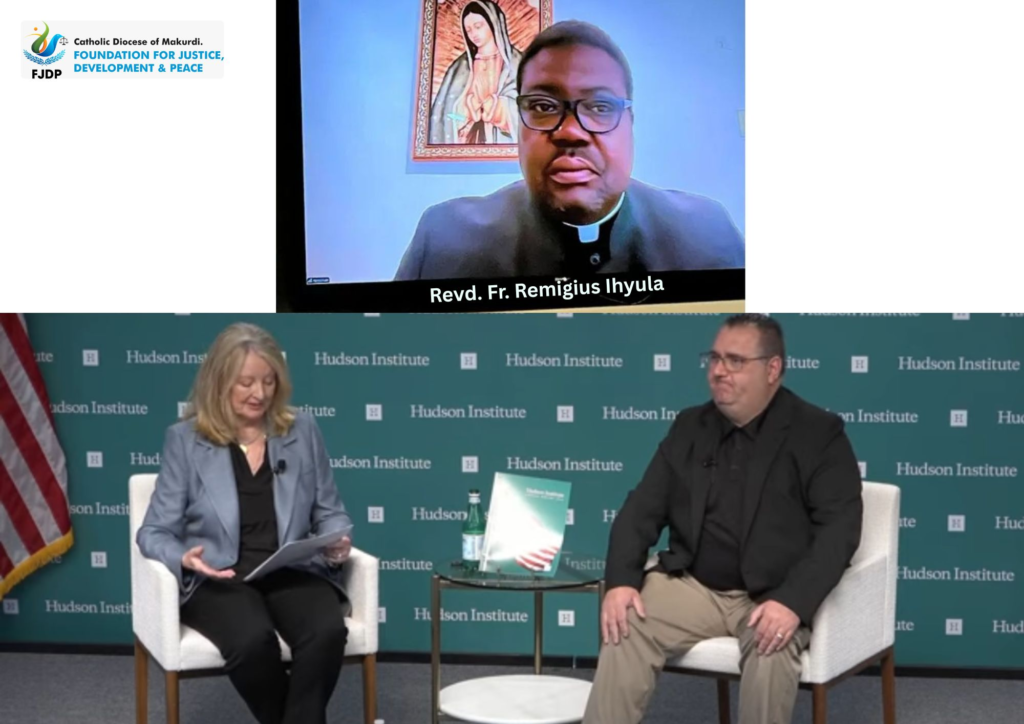
Revd. Fr. Remigius Ihyula Advocates for Security Restoration and Return of IDPs to Ancestral Lands at Hudson Institute Conference
Amid persistent attacks on communities across Nigeria, particularly in the Middle Belt region, which have displaced thousands of people into Internally Displaced Persons (IDP) camps, Revd. Fr. Remigius Ihyula has called for the restoration of security and the safe return of displaced persons to their ancestral lands.
Fr. Remigius made the call on August 29, 2026, while participating as a panelist at a conference organized by the Hudson Institute in United State, on violence and insecurity in Nigeria. He joined other panelists, including George Soul, Founder of Equipping the Persecuted, to discuss the nature, impact and humanitarian consequences of violence affecting communities across the country.
Speaking particularly on the situation in Benue State, Fr. Remigius shared his understanding of the prolonged crisis and its devastating impact on affected communities and the Catholic Diocese of Makurdi. He noted that persistent attacks have resulted in deaths, mass displacement, destruction of homes and properties, disruption of economic activities and widespread despair among affected populations.
He stressed the need for authorities to restore security in the affected communities and create the necessary conditions for IDPs to safely return to their ancestral lands, rather than remaining indefinitely in displacement camps.
A Crisis That Predates 2001
Recounting the history of the crisis, Fr. Remigius explained that attacks on communities in Benue had been occurring long before 2001. However, he said the scale and frequency of displacement eventually prompted the Catholic Diocese of Makurdi to systematically document and respond to the situation.
According to him, the Diocese began paying closer attention to the crisis in 2001 as large numbers of people were killed and forced to flee their homes. In collaboration with Catholic Relief Services (CRS), the Diocese supported the establishment of an IDP camp to provide assistance to displaced communities.
He further explained that some of the earliest incidents occurred around border communities between Benue and Nasarawa, Benue and Taraba, and Benue and Cameroon.
Pattern and Impact of Attacks
Drawing from experiences gathered from affected communities, Fr. Remigius described the pattern of attacks as particularly devastating, noting that attackers often invade communities at night when residents are asleep.
According to him, the attacks have involved killings, sexual violence, the destruction and burning of homes and communities, and attacks on people attempting to flee. He also recounted instances in which pregnant women were reportedly attacked and people were wounded while attempting to escape.
He noted that some victims later died while the Church and other humanitarian actors attempted to evacuate them or facilitate access to medical care.
In his words, “The violence in the communities is against anybody on sight, including men, women, the elderly and disabled, anybody who is unfortunate to be in the location where the attack occurred.”
Fr. Remigius highlighted the scale of the humanitarian crisis, stating that hundreds of people have been killed, thousands injured and millions displaced, many of whom continue to live in camps with limited access to assistance and basic services.
The Church and the Loss of Hope
Fr. Remigius emphasised that although the attacks predated 2001, the situation was not initially understood or addressed as part of a broader organised agenda. He said the Catholic Diocese of Makurdi began systematically responding to the crisis when the killing and mass displacement of communities became increasingly evident.
He further stressed that the Church itself has been deeply affected by the violence, as its structures, personnel and communities have been caught up in the crisis.
According to him, the prolonged conflict is not only destroying homes and livelihoods but also taking away the hope of affected populations. He noted that the Church has historically been a source of hope and support for underserved and vulnerable communities, making the continued violence particularly concerning.
Fr. Remigius’ call at the conference underscores the urgent need for stronger security measures, sustained humanitarian support and durable solutions that will enable displaced communities to return safely, rebuild their lives and restore their livelihoods in their ancestral homes.